



Does AI content rank in Google? According to a Semrush study of SEO practitioners, 72% say AI-generated content performs at least as well as human-written content in search. Ahrefs found that 86.5% of top-ranking pages already contain some AI-generated content. The evidence is not ambiguous: AI content ranks, and it does so at scale.
Key takeaways
- 72% of SEOs report AI content ranks at least as well as human-written content.
- 86.5% of top-ranking pages already contain some AI-generated content.
- Google penalizes low-quality spam, not AI assistance; the tool used does not determine ranking.
- 64% of SEO teams use a human-led, AI-assisted workflow as their standard production model.
The real question is what separates AI content that holds page-one positions from AI content that gets filtered out. Google's March 2024 Core Update answered that clearly. The target was low-quality, mass-produced content built to manipulate rankings, not AI assistance itself. Quality and user intent are the ranking factors. The tool used to produce the content is not.
What Google Actually Evaluates in Search Rankings
Google's ranking algorithm does not have an "AI penalty" switch. It evaluates pages on quality, relevance, and user value regardless of how the content was produced. Google has said this directly: content that is useful, helpful, and original can rank, full stop. The authorship method is not a ranking signal. A page written entirely by a human that fails to answer the search query will lose to an AI-assisted page that answers it precisely. That is the actual standard.
Google's Own Guidance on Automation and Spam
Google's developer documentation states plainly: "Not all use of automation, including AI generation, is spam."1 The distinction Google draws is between AI used to help users and AI used to manipulate rankings. Content generated at scale with no user value in mind, thin articles stuffed with keywords, pages that exist only to capture clicks, that is what Google targets. AI assistance used to research, draft, or refine content that genuinely serves a reader is a different category entirely. Conflating the two is the source of most of the confusion in this space.
What the March 2024 Core Update Actually Targeted
Google's March 2024 Core Update is frequently described as an "AI crackdown." That framing is inaccurate. The update targeted low-quality, mass-produced content built to game search results, whether that content was generated by a human or a machine. Google noted that concerns about mass-produced content predate AI: "About 10 years ago, there were understandable concerns about a rise in mass-produced yet human-generated content."2 The update extended the same logic to AI-generated spam. Sites that lost rankings after March 2024 were not penalized for using AI. They were penalized for publishing low-value content at scale.
The Data on AI Content Performance in Search
The performance data is consistent across multiple studies. Semrush surveyed SEO practitioners and found 72% report AI content ranks at least as well as human-written content.3 Ahrefs analyzed the top 20 ranking pages across a broad sample of queries and found that 86.5% contain some AI-generated content, meaning fully human-written content now represents only 13.5% of top-ranking pages.4 These are not edge cases. AI-assisted content is already the norm at the top of search results.
How SEO Teams Are Actually Working Today
The most common content production model in SEO teams is human-led, AI-assisted. Semrush found 64% of teams operate this way, with humans directing strategy, editing drafts, verifying facts, and making final publishing decisions.3 When you add fully human-created content to that figure, 87% of SEO teams report their content is either entirely human-created or heavily human-led.3 Fully automated, unreviewed AI publishing is a fringe practice, not the industry norm. The teams ranking well are using AI as a production tool, not as a replacement for editorial judgment.
A Worked Example: AI Content Ranking on Page One
One widely cited example involves a ChatGPT-generated article about printers that ranked on page one for over 70 keywords. The article was not published raw. It went through prompt engineering to target a specific audience and search intent, human review to verify accuracy, and structural editing to match the format readers expect. The result was content that answered real questions thoroughly and ranked accordingly. The lesson is not "use ChatGPT and rank." The lesson is that AI-generated content, treated with the same editorial standards as human-written content, can compete at the top of search results.
E-E-A-T and AI-Generated Content
Google's quality evaluator guidelines center on Experience, Expertise, Authoritativeness, and Trustworthiness. These criteria apply to the content and the site, not to the production method. An AI draft that incorporates first-hand experience signals, cites authoritative sources, and is reviewed by a credentialed author can satisfy E-E-A-T. A human-written article with no citations, no author credentials, and no original perspective cannot. The framework has always been about what the content demonstrates, not how it was typed.
- ✓First-hand experience in the text
- ✓Sources cited, and linked
- ✓Reviewed by a credentialed author
- ✓An original position on the question
- ✕No experience the reader can check
- ✕No citations
- ✕No named author or credentials
- ✕Restates what every other page says
Quality Depends on Process, Not the Tool
The misconception that AI content is inherently lower quality than human content conflates the tool with the process. A poorly prompted, unreviewed AI draft is low quality. So is a rushed, unedited human draft. Quality is a function of the brief, the prompt, the editorial review, the fact-checking, and the structural decisions made before publishing. "Google doesn't reward content because a machine made it."1 It also does not penalize content because a machine assisted. The output is what gets evaluated, and the output quality is entirely within the content team's control.
What Separates Ranking AI Content from Spam
Google penalizes low-value AI content created solely for ranking purposes.5 The distinguishing characteristics of penalized content are recognizable: no original perspective, no factual depth, generic structure that mirrors other pages rather than answering the specific query, and volume produced at a rate no editorial team could review. Ranking AI content looks different. It has a clear topical angle, cites sources, reflects actual expertise or experience, and answers the query more completely than competing pages. The difference is not AI versus human. It is original, helpful content versus content that exists to fill a keyword slot.
The Practical Workflow That Produces Ranking Content
Teams using AI effectively follow a consistent pattern. Research and competitive analysis inform the brief. AI tools handle the initial draft, pulling together structure and covering the expected subtopics. A human editor reviews for accuracy, adds original observations or data, adjusts the tone, and verifies every factual claim. Understanding how to instruct AI tools correctly at the brief and prompt stage is what determines whether that review catches minor refinements or fundamental problems. The final version goes through a quality check before publishing. This workflow produces content faster than fully manual production without sacrificing the editorial oversight that separates ranking pages from filtered ones. The AI handles the drafting load. The human handles the judgment calls.
AI Detection Tools and Google Penalties
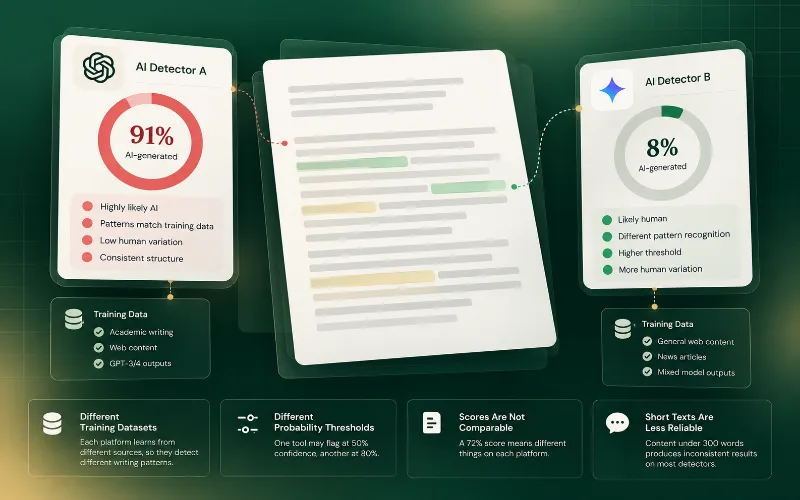
A common concern is that Google uses AI detection tools to identify and penalize AI-generated content. There is no credible evidence that Google does this, and Google has not indicated that AI detection is part of its ranking process. Current AI detection tools produce significant false-positive rates and cannot reliably distinguish AI-assisted from human-written content, particularly when content has been edited by humans. Google's stated approach is to evaluate content quality signals, not to identify the production method. Building a content strategy around avoiding detection is solving the wrong problem. Building one around producing genuinely useful content is the right problem.
What This Means for Content Strategy Going Forward
The data reframes the question. With 86.5% of top-ranking pages already containing AI-generated content, the question is no longer whether AI content can rank. It demonstrably does. The strategic question is whether a team's AI-assisted workflow produces content that meets the quality bar Google rewards: specific, accurate, well-structured, and genuinely helpful to the reader. Teams that treat AI as a drafting accelerator within a human-led editorial process are operating in line with both the data and Google's stated guidance. For broader compliance and ranking strategy context, the production model is only one part of a sustainable search approach. Teams that treat AI as a publish button are the ones the March 2024 update was designed to address.
AI-Assisted Content Creation: The Bottom Line
The data is settled enough to act on. AI content ranks in Google when it meets the same quality bar that human-written content has always had to meet: specific, accurate, helpful to the reader, and structurally sound. Google penalizes manipulation, not assistance. The teams performing well are using AI to accelerate production while keeping human judgment in the loop for accuracy, tone, and editorial decisions.
If your team is still debating whether to adopt AI tools, the more pressing question is whether your current workflow produces content that meets that quality bar consistently. After publishing, use Google Search Console to measure ranking performance and verify that quality is translating into search visibility. Verand's compliance and quality checks run before any draft reaches a human reviewer, so the editorial time you do spend goes toward decisions that matter, not catching problems that code can catch first.
Frequently asked questions
Can Google detect AI-generated content and penalize it?
Google has not indicated it uses AI detection as a ranking signal, and current detection tools carry significant false-positive rates. Google evaluates content quality, not production method. Publishing helpful, accurate content is the correct strategy regardless of how it was drafted. Our AI content disclosure rules explain how we apply that standard on this site.
Did the March 2024 Core Update target AI content specifically?
No. It targeted low-quality, mass-produced content built to manipulate rankings. That includes spam-like AI content, but also low-value human-written content. The update was about quality, not authorship method.
Does fully AI-generated content rank, or does it need human editing?
The data shows AI-assisted content ranks consistently when editorial standards are applied. Human review for accuracy, original perspective, and structural quality is what separates ranking pages from filtered ones, not the presence or absence of AI involvement.
What percentage of top-ranking pages are purely human-written?
According to Ahrefs research, only about 13.5% of top-ranking pages contain no AI-generated content. The overwhelming majority already include some AI assistance, making fully human-written content the exception at the top of search results.
Is a human-led, AI-assisted workflow required to rank, or can teams automate more?
Human oversight is not a strict technical requirement, but the data correlates with it. Fully automated, unreviewed publishing is a fringe practice among ranking teams. The 64% human-led, AI-assisted adoption rate reflects where editorial quality and ranking performance intersect.
Sources
External
- Semrush, "Does AI Content Rank in Search? Data Study"
- Ahrefs, "AI-Generated Content Does Not Hurt Your Google Rankings"
- Google Search Central, "Google Search's Guidance About AI-Generated Content"
- SEO Sherpa, "Does Google Penalize AI Content?"
- SEO.com, "Google and AI Content"