


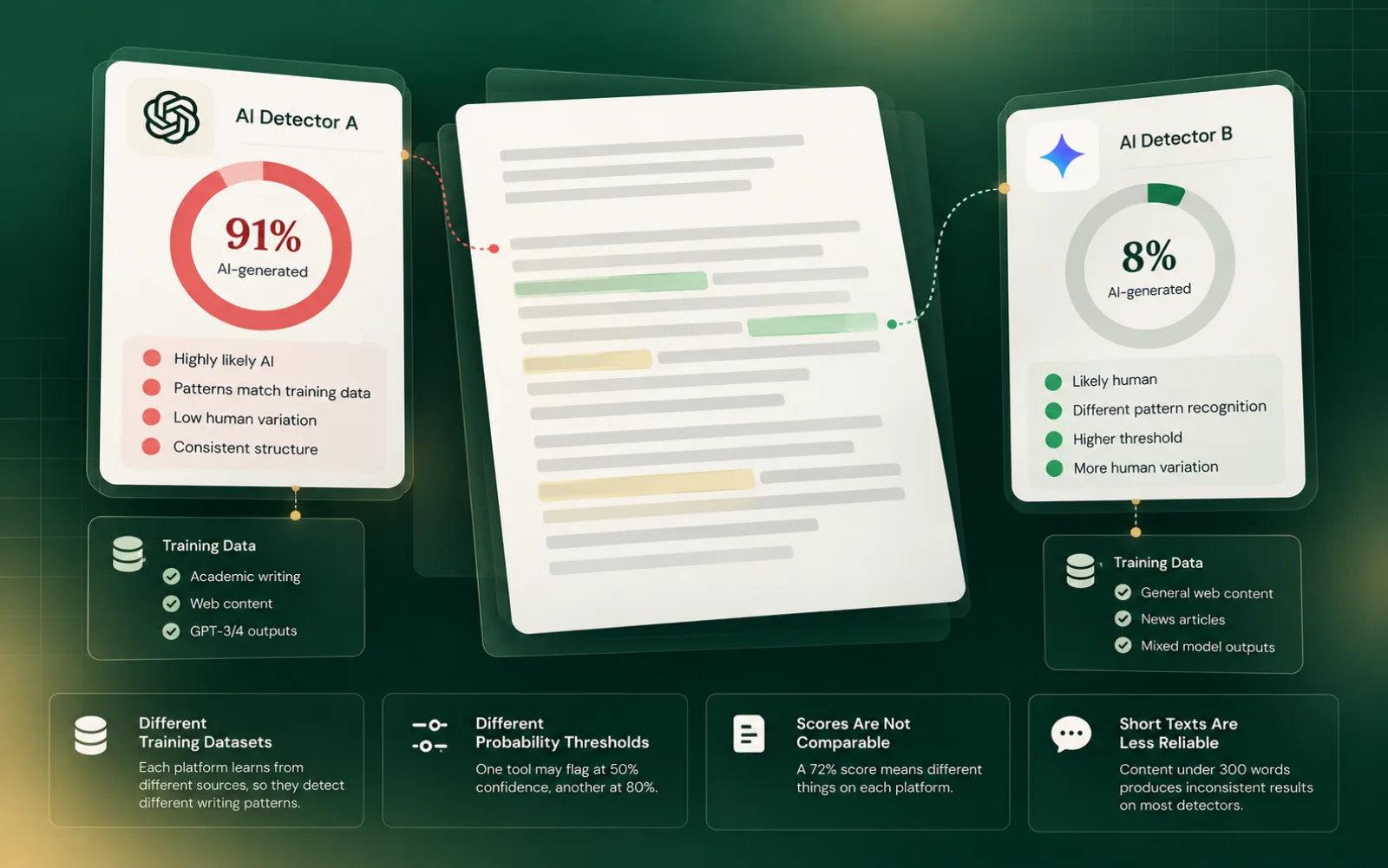
You paste the same 500-word essay into two AI detectors. One returns 91% AI-written. The other returns 8%. The text hasn't changed. Why do different AI platforms show different results this dramatically? The answer isn't that one tool is broken. It's that each system was built with different training data, different probability thresholds, and different definitions of what "AI-written" actually means.
Key takeaways
- Different training datasets cause detectors to recognize different writing patterns as AI-generated.
- Probability thresholds vary: one platform flags at 50% confidence, another requires 80%.
- A score of 72% means something different on every platform; scores are not comparable across systems.
- Text under 300 words produces unreliable results on most detection platforms.
That inconsistency is frustrating, especially when a score carries real consequences in a classroom or a content workflow. But the variance is a predictable outcome of how these systems are designed, not a sign of malfunction. Understanding the mechanics behind it is what lets you read any detection report accurately, without over-relying on a single number from a single platform. Verand's stance on AI-generated content use reflects exactly this kind of methodological caution.
Different Training Datasets Produce Different Pattern Recognition
Every detection platform trains on a corpus of human-written and AI-generated text. The model learns to distinguish between them by recognizing statistical patterns: word choice frequency, sentence structure regularity, predictability of the next token. The problem is that no two platforms use the same corpus. One system may train heavily on academic writing; another on web content; a third on a mix of GPT-3 and GPT-4 outputs. Each learns to recognize a different fingerprint of AI authorship, so each will score the same passage differently based on which patterns it was taught to weight.1
Training Data Quality and Quantity Both Shape Accuracy
More training data generally improves accuracy, but does not guarantee it.1 A detector trained on ten million examples but with poor labeling, outdated model outputs, or narrow stylistic range will underperform a smaller but cleaner dataset. If a platform's training corpus predates a major model release, it may have no reference for that model's specific output patterns. No single detection strategy eliminates the variability that weak or inconsistent training data introduces across the industry. The gaps in one platform's training are invisible to the user, which is exactly why scores diverge.
Probability Thresholds Differ by Design
After a model assigns a probability score to a passage, the platform applies a threshold: the cutoff at which it calls text AI-generated. One system flags anything above 50% probability as AI-written, while another may require 80% certainty before flagging text. That 30-point gap means a passage sitting at 65% confidence clears one platform entirely and triggers a flag on the other. The text is identical. The underlying probability estimate may even be similar. What changed is the classification boundary, and that boundary is a design choice, not a universal standard.
A Concrete Example: 90% on One Platform, 10% on Another
The same essay can receive a 90% AI score on one platform and a 10% score on another, not because the text changed, but because the classification boundary moved.3 Running the same content across multiple detectors produces this result routinely. The experience confirms what the methodology predicts: when two systems use different training corpora and different thresholds, opposite verdicts on the same text are not surprising. They are the expected outcome. Treating either score as definitive truth ignores how the system that produced it was built.
Scores Are Not Comparable Across Platforms
A score of 72 in one detection system is not necessarily comparable to 72 in another.4 The number looks the same, but it represents a confidence estimate calculated against a specific model's internal scale, trained on a specific dataset, with a specific threshold applied. Think of it less like a temperature reading, where 72°F means the same thing on any thermometer, and more like a letter grade issued by two professors with different rubrics. Both gave a B. What earned that B is entirely different. Comparing scores across platforms as if they share a common scale is a category error.
Document-Level Versus Sentence-Level Reporting
One platform may report a document-level likelihood while another reports a sentence-level probability.4 A document-level score averages across the entire text, which can mask a few highly flagged paragraphs inside an otherwise human-written piece. A sentence-level report surfaces those specific passages but may produce a different aggregate impression. Neither approach is wrong. They answer different questions. When two platforms produce different outputs on the same document, it is worth checking whether they are even measuring the same unit of analysis before concluding that one is more accurate.
Text Length Has a Direct Effect on Detection Reliability
Detectors are more accurate on passages of 300 or more words, and very short texts can produce unreliable results.3 Testing AI detection on short passages confirms this directly. Results become more consistent as word count increases, and the shortest passage where a detection result feels meaningful is around 100 words. Below that, the signal-to-noise ratio is poor enough that the score tells you very little. If you are evaluating a 75-word abstract or a brief paragraph, treat the output as directional at best, not as a reliable verdict.
Different Models Were Built for Different Purposes
Detection systems are not all trying to solve the same problem. Some are optimized for academic integrity, trained heavily on student writing and essay-format AI outputs. Others target marketing or web content, where the stylistic signatures of AI writing differ substantially. A model tuned for one context will apply its learned patterns to any text it receives, including text from a context it was never trained on. That mismatch produces scores that reflect the model's training context as much as the actual text. Understanding what a platform was built for helps explain why its results diverge from a platform built for a different purpose.
Treat Every Score as a Confidence Estimate, Not a Verdict
A detection score is the system's confidence that the text matches the patterns it associates with AI-generated writing, given its specific training data and threshold. It is not a determination of authorship. A 91% score does not prove AI wrote the text; it means this system, with this training, at this threshold, is 91% confident the text resembles what it learned to flag. That is a meaningful signal, but it is tied to one system's methodology. Understanding the differences between detection systems helps you judge every report more carefully and avoid treating any single output as definitive.5
No Universal Detection Standard Exists Across the Industry
There is no governing body that certifies what counts as AI-written text or mandates a common threshold, a regulatory context for AI detection concerns that continues to evolve as institutions develop their own policies. Each platform sets its own definitions, trains its own models, and draws its own classification boundaries. That means the industry as a whole produces inherently inconsistent outputs, and no single detection strategy eliminates the variability that weak or inconsistent training data introduces. Expecting cross-platform consistency from systems with no shared standard is the wrong baseline. The more useful expectation is that each platform gives you one informed perspective, not a universal truth.
Reading a Platform's Methodology Changes How You Interpret Its Output
Most detection platforms publish documentation describing their approach: what they trained on, how they define confidence, whether they report at the document or sentence level, and what their flagging threshold is. The same principle applies when you configure AI tools for compliant outputknowing the methodology behind a tool shapes how you interpret and act on its results. That documentation is worth reading before placing weight on any score. A platform that flags at 50% confidence is making a different claim than one requiring 80%. A platform trained on GPT-4 outputs will have different blind spots than one trained on a broader model mix. The score only makes sense in the context of the methodology that produced it. Without that context, the number is incomplete information.
Using Multiple Detectors Produces a More Defensible Interpretation
Checking the same text across multiple detectors, then reading each platform's methodology documentation, gives you a more defensible interpretation than any single score. When two platforms with different training corpora and different thresholds both flag the same passage, that convergence carries more weight than one platform's verdict alone. When they diverge, the divergence itself is informative: it tells you the text sits near a classification boundary, which means the signal is genuinely ambiguous. Neither platform is wrong. Both are reporting their honest estimate. The responsible use of detection tools is to treat that pattern of agreement and disagreement as the actual data, not to pick the score that confirms a prior conclusion.
AI Detection Scores: The Bottom Line
A detection score is one system's probability estimate, calibrated to its own training data and threshold. It is not a universal measurement, and it is not comparable to the same number from a different platform. The variance you see across detectors is the natural result of different design choices, not a signal that the tools are broken or that the results are meaningless.
If your workflow involves reviewing AI-generated content before it publishes, the same logic applies to the broader content process: a single automated check is one data point. Verand runs 46 deterministic checks on every draft before a person sees it, precisely because no single score tells the whole story, checks that are grounded in defined quality standards AI detection helps enforce. The same principle that makes multi-platform detection more reliable makes structured, code-based content review more trustworthy than any single automated pass.
Frequently asked questions
Can the same text genuinely score 90% on one detector and 10% on another?
Yes. When two platforms use different training corpora and different classification thresholds, opposite verdicts on identical text are an expected outcome, not an error. The text hasn't changed; the boundary that determines the verdict has.
Does a higher score mean a platform is more accurate?
No. A higher score reflects greater confidence within that system's specific methodology. Accuracy depends on training data quality and relevance to the content type, not on how high the number is.
Why do detection results vary even when I run the same text twice on the same platform?
Some platforms introduce randomness in their inference process, and document segmentation can shift slightly between runs. Minor variation on a single platform is normal. Large swings suggest the text sits near the classification boundary.
Should I trust a detection result on a short paragraph or email?
Treat it as directional only. Most detectors become meaningfully reliable at 300 or more words. Below 100 words, the statistical signal is too thin to support a confident verdict.
Is there a detection platform that all schools or organizations agree to use as a standard?
No universal standard exists. Each institution selects its own tool, and no governing body certifies a common threshold or methodology. That's why institutional policies increasingly specify which platform they use and how scores are weighted.
Sources
External
- trinka.ai, "Why Different AI Content Detectors Give Different Results on the Same Text"
- detecting-ai.com, "Why AI Detectors Give Different Results"
- turnitin0.com, "Why Do Different AI Detectors Give Different Scores on the Same Essay?"
- techbuzzireland.com, "Why Different AI Detection Tools Give Different Results"