


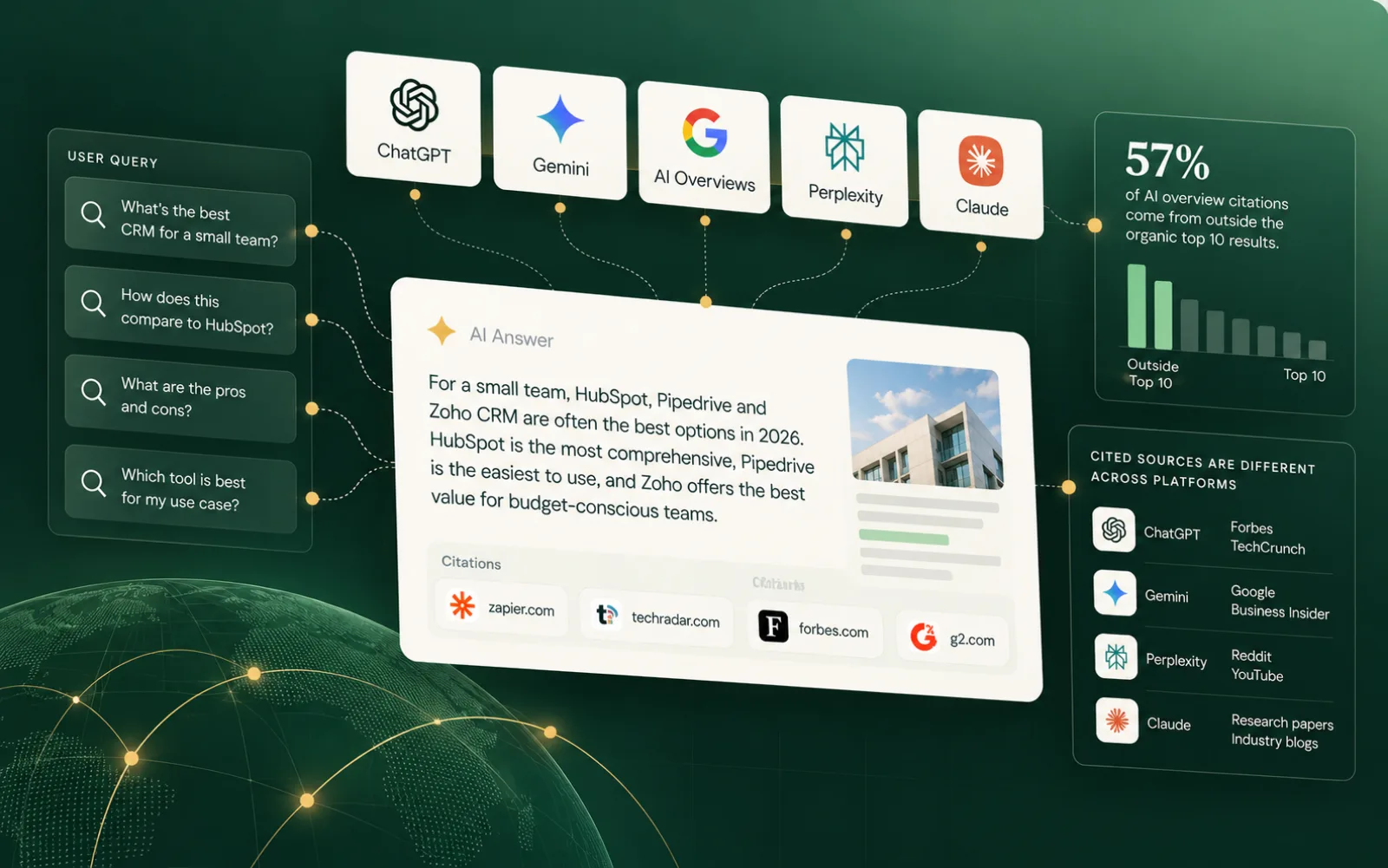
What is the future of AI answer engines is a question that moved from theoretical to urgent in under two years. Perplexity reached 100 million weekly queries by October 2024. ChatGPT launched in November 2022 and immediately applied competitive pressure to a search market Google had held at roughly 90% for two decades. The numbers are real, and the shift is already underway.
Key takeaways
- AI answer engines synthesize sourced answers conversationally rather than returning a ranked link list.
- 57% of AI overview citations come from outside the organic top 10 results.
- Different engines cite different sources: Reddit dominates Perplexity, not ChatGPT.
- Quality, well-sourced content is more valuable in an AI-answer world, not less.
That does not mean SEO is over. It means the user journey is fragmenting. A growing share of queries now resolve inside an AI-generated answer rather than a ranked list of links, and the content that gets cited there follows different rules than the content that ranks on page one. Understanding those rules is what separates teams that adapt from teams that lose ground quietly.
What Is an AI Answer Engine?
A traditional search engine returns a ranked list of links. You click, you read, you form your own answer. An AI answer engine skips that step. It synthesizes information from multiple sources, reasons across them, and delivers a direct conversational response, with citations attached.
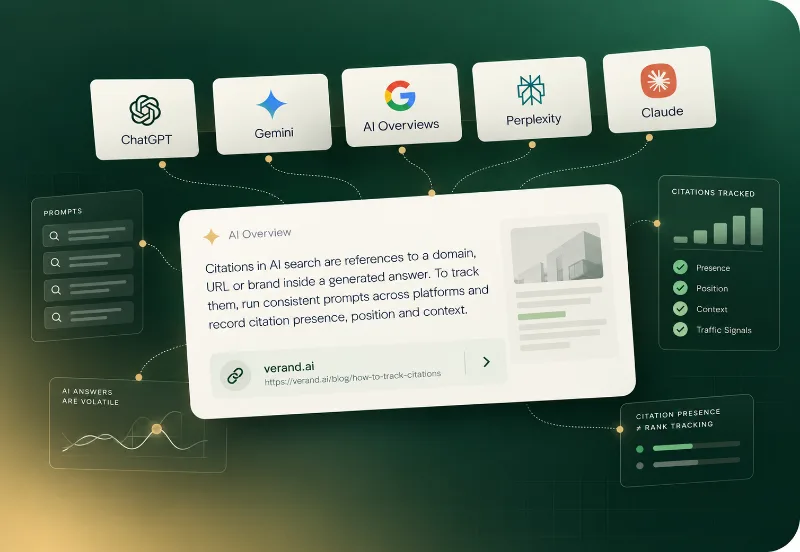
Perplexity, ChatGPT's search mode, Google AI Overviews, Gemini, and Claude all operate this way. The user asks a question in natural language. The engine reads across dozens of sources in real time, compresses the relevant information, and surfaces a composed answer. The links are still there, but they're footnotes now, not the destination.
That structural difference matters. When the answer lives inside the engine's response, the user's journey ends before it reaches your site. Visibility in that answer, not a ranking position, becomes the new metric that counts. Platforms built around core capabilities enabling next-generation answer engines make it possible to monitor that visibility systematically across engines.
The Scale of the Shift in Search Queries
The numbers make the case plainly. Perplexity handled 100 million weekly queries by October 2024, compared to 500 million total across all of 2023.1 That trajectory, from 500 million annual to 100 million weekly in under a year, is not a niche signal. It is a behavioral shift at scale.
Google still holds roughly 90% of the global search market and has for more than two decades.2 That dominance is not collapsing overnight. But the November 2022 launch of ChatGPT introduced the first credible alternative to link-based search at consumer scale,3 and the growth curves since then have not leveled off. The two models will coexist, but the share of queries that resolve inside an AI answer is growing every quarter.
Putting the Platform Shift in Context
Every decade or so, a new layer rewires how people find information and make decisions. The web itself was the first. Mobile reshaped it in 2004. Social media added a discovery layer in 2009. Each transition looked optional at first, then mandatory.
AI answer engines are the next layer. The argument that this shift is comparably monumental to mobile or social is not hyperbole when you look at the mechanism: for the first time, users can get a synthesized, sourced answer without visiting a single publisher's page. That changes the economics of content production, the measurement of brand visibility, and the definition of what it means to rank.
Teams that treated mobile optimization as optional in 2006 spent years catching up. The same risk applies here, not because search is dying, but because the definition of search is expanding faster than most content strategies are.
How User Behavior Is Changing Across Search Platforms
Users are not just switching tools. They are changing how they frame queries. Conversational questions, "what should I do if," "which is better for," "explain the difference between," perform better in AI engines than keyword strings. That is not a coincidence. AI answer engines were built for natural language, and users have adapted quickly.
Voice search accelerates this. Approximately 50% of searches are now voice-based, and voice queries are almost always phrased as complete questions. AI answer engines handle those natively. A keyword-optimized page built for "best CRM software 2024" does not map cleanly onto "what CRM works best for a five-person sales team that already uses Slack?" The content architecture that wins in AI search is built around the second format, not the first.
The Citation Paradox: Rankings Do Not Equal Visibility
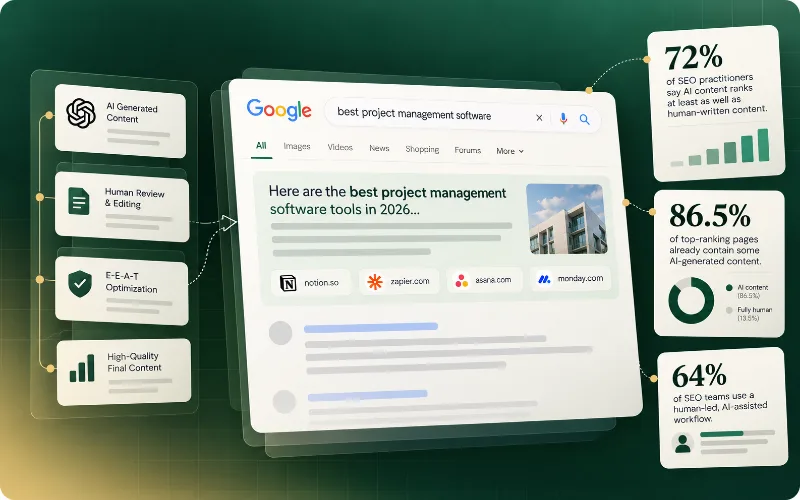
Here is the structural problem that catches most teams off guard. Ranking in the organic top 10 no longer guarantees a citation in AI-generated answers. Fifty-seven percent of citations in AI overviews come from outside the organic top 10.
That is not a rounding error. It means the majority of sources an AI engine cites are pages that would not even appear on the first page of a standard Google results list. The selection criteria are different. AI engines weight structure, directness, and source credibility over raw ranking position.
- 1
- 2
- 3cited
- 4
- 5
- 6
- 7cited
- 8
- 9cited
- 10
Here are the best options in 2026, based on how teams actually use them…
The most common gap identified in content that ranks well but receives zero AI citations is that it fails to answer the query early enough in the article. A page that buries its core answer in paragraph eight, after 600 words of context-setting, will be passed over. AI engines pull the answer they need, and if it is not surfaced quickly, they pull it from somewhere else.
Source Preferences Vary Significantly Across Engines
Assuming all AI answer engines cite from the same pool of sources is a mistake. The data shows sharp divergence. Reddit accounts for nearly half of Perplexity's top citations, compared to under 10% for ChatGPT.
That gap reflects different training priorities and retrieval architectures. Perplexity weights community-sourced, high-engagement content. ChatGPT's search mode leans toward publisher authority and structured editorial content. Google AI Overviews favor pages already indexed with strong E-E-A-T signals. Gemini and Claude each have their own source hierarchies.
 Perplexity
 ChatGPT search
 Google AI Overviews
 Gemini
 Claude
The practical implication: a single content strategy optimized for one engine will underperform on others. Brands that want consistent citation across platforms need to think about source diversity, community presence, and editorial credibility simultaneously, not sequentially.
The Brand-Building Opportunity in AI Answers
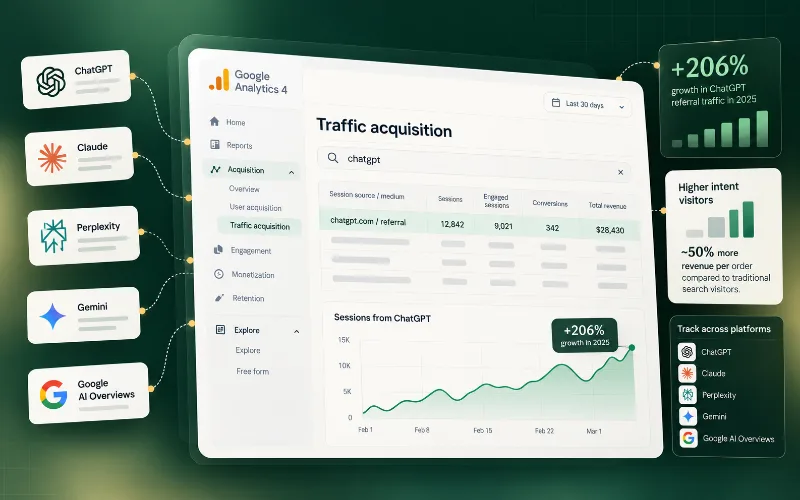
Citations in AI answers do not always drive immediate click-through traffic. That is an honest caveat worth stating plainly. But a brand cited in 40% of AI answers for a competitive query set builds topical authority and brand association that compounds over time, even without a direct traffic spike.
Think of it as the equivalent of being named in every industry analyst report in your category. The citation itself shapes perception. Users who see your brand appear consistently in AI-generated answers across multiple queries start to associate your name with expertise in that topic, whether or not they click through on any given occasion.
That requires a new measurement framework. Share of voice in AI answers, tracked per prompt and per engine, is a distinct metric from organic traffic or keyword rankings. Teams that measure only traditional signals will miss the accumulating authority being built, or lost, in AI-generated responses.
E-E-A-T Signals and Unexpected AI Citations
One pattern worth noting: brands sometimes appear in AI answers for queries their traditional SEO strategy was not targeting at all. When that happens, the most consistent explanation is strong E-E-A-T signals. Experience, expertise, authoritativeness, and trustworthiness, expressed through author credentials, cited sources, and first-hand specificity, give AI engines reason to pull from a page even when the page was not built around that exact query.
This is meaningfully different from how traditional search works. A page optimized for one keyword cluster can receive AI citations for adjacent queries, because the engine is evaluating the credibility of the source, not just the keyword match. That is an opportunity: brands that invest in genuine depth and verifiable credentials build a citation surface that extends beyond their targeted keyword set.
AI Answer Engines Are Expanding Globally
This is not a US-only shift. Since 2024, AI answer engines have expanded across mobile and desktop in multiple languages and regions. Perplexity operates in dozens of languages. Google AI Overviews have rolled out across major markets outside the US. ChatGPT's search functionality is available globally.
For brands with international audiences, the citation gap is not a future problem. It is already active in markets where AI search adoption is accelerating faster than local content strategies have adapted. A brand that dominates German-language organic search but has no presence in German-language AI answers is losing a growing slice of discovery to competitors who do.
The multi-region dimension also means that source-preference patterns will vary by market. Community platforms that dominate citations in one region may be irrelevant in another. Building a global AI visibility picture requires tracking prompts in each target language, not just translating a US-centric strategy.
What SEO Adaptation Actually Looks Like
Traditional on-page optimization still matters. Backlinks, meta structure, crawlability, and page authority are not obsolete. They remain the foundation. What has changed is that foundation alone is no longer sufficient for AI-answer visibility.
The additions are specific. Content needs to answer the query directly and early, ideally in the first two to three paragraphs. Structure matters: headers that mirror natural questions, concise answers positioned before supporting detail, and tables or formatted takeaways that AI engines can parse and cite. Long-tail, conversational queries need dedicated coverage, not just incidental mentions buried in broader pieces.
Source credibility signals, author credentials, cited data, and named expertise, carry weight that keyword density never did. AI engines are evaluating whether a source is trustworthy enough to cite in front of a user who is relying on the answer. That is a higher bar than ranking for a keyword, and it rewards the same investment that E-E-A-T has always rewarded: genuine depth from credible sources.
Content Strategy Implications for AI-Native Search
Quality, well-sourced content is more valuable in an AI-answer environment, not less. That is the counterintuitive reality that reassures teams worried their existing content is suddenly obsolete. AI engines cite sources. They actively pull from pages that contain specific, verifiable, well-structured information. Generic, keyword-padded content gets passed over in favor of pages that actually contain the answer.
The practical shift is toward depth over breadth. A single comprehensive, well-cited article on a specific question will outperform ten thin pieces covering adjacent territory. Content audits should prioritize identifying pages that rank but never get cited, then asking whether the answer is surfaced early, whether the sourcing is credible, and whether the structure is readable by a machine pulling a paragraph-level excerpt.
Teams that have invested in editorial standards, author expertise, and cited data are better positioned for AI-answer visibility than teams that have optimized purely for keyword density. The investment compounds rather than depreciates. For a deeper look at compliance and SEO considerations for AI-generated content, the Verand blog covers evolving best practices across both surfaces.
The Trajectory Through 2026 and Beyond
By 2026, search is expected to move further toward context-aware, conversational responses that anticipate follow-up questions and execute multi-step tasks, not just answer single queries.4 The single-question, single-answer model is an early iteration. Engines are already beginning to chain queries, retain session context, and integrate real-time data.
That trajectory makes the current window important. Brands that build AI-answer visibility now, through structured content, credible sourcing, and tracked citation share, are establishing authority in a surface that will only grow in influence. Brands that wait for the shift to feel more settled will be optimizing for a landscape that has already moved past them.
The coexistence of traditional search and AI answer engines is not a temporary transition state. It is the durable structure of search going forward. Both surfaces require attention, and the content attributes that win in AI answers, depth, credibility, directness, happen to strengthen traditional search performance as well. That alignment is the practical case for acting now rather than watching longer.
AI Search Visibility: The Bottom Line
The shift toward AI answer engines is not a reason to abandon what works in traditional search. Backlinks, page authority, and on-page structure still matter. What has changed is that they are now necessary but not sufficient. A page that ranks on page one but answers its core question in paragraph nine will lose citations to a page that ranks on page three but leads with the answer. Structure and directness now carry weight they never did before.
If you want to understand where your brand stands in AI-generated answers today, across ChatGPT, Gemini, Perplexity, Google AI Overviews, Google AI Mode, and Claude, Verand tracks citation share, mention sentiment, and prompt-level visibility across all six engines. The data tends to surface gaps that traditional rank tracking misses entirely.
Frequently asked questions
What is Answer Engine Optimization (AEO) and how does it differ from SEO?
AEO is the practice of structuring content so AI answer engines cite it in generated responses. Traditional SEO targets ranking position in a link list. AEO targets citation in a synthesized answer, which requires direct answers positioned early, strong source credibility, and structured formatting AI engines can parse. AI prompt templates can help structure content for answer engine optimization.
Will AI answer engines replace Google?
Not in the near term. Google holds roughly 90% of global search market share and is building its own AI answer layer through AI Overviews and AI Mode. The more accurate picture is fragmentation: multiple platforms handling different query types, with Google remaining dominant while AI-native engines claim a growing share.
How do I know if my brand is being cited in AI-generated answers?
You track it by running a defined set of prompts across each engine and recording whether your brand appears, how often, and in what context. Manual spot-checking works at small scale. Platforms built for AI visibility monitoring automate this across ChatGPT, Gemini, Perplexity, Google AI Overviews, Google AI Mode, and Claude simultaneously. Tracking search visibility metrics across answer engines alongside traditional Search Console data gives the most complete picture of where brand authority is being built or lost.
Does a citation in an AI answer actually drive traffic to my site?
Not always directly. Click-through rates from AI citations are lower than from organic links because the user often has their answer before clicking. The value is brand association and topical authority that accumulates across repeated exposures, which influences decisions made later through other channels.
Which types of content are most likely to be cited by AI answer engines?
Pages that answer the query directly in the first few paragraphs, use structured formatting such as headers and tables, cite verifiable sources, and carry identifiable author credentials. Thin, keyword-padded content and pages that bury the core answer deep in the body are consistently passed over.
Sources
External
- cacm.acm.org, "Answer Engines Redefine Search"
- socialprachar.com, "Discover AI Search Engines: The Future of Search"