


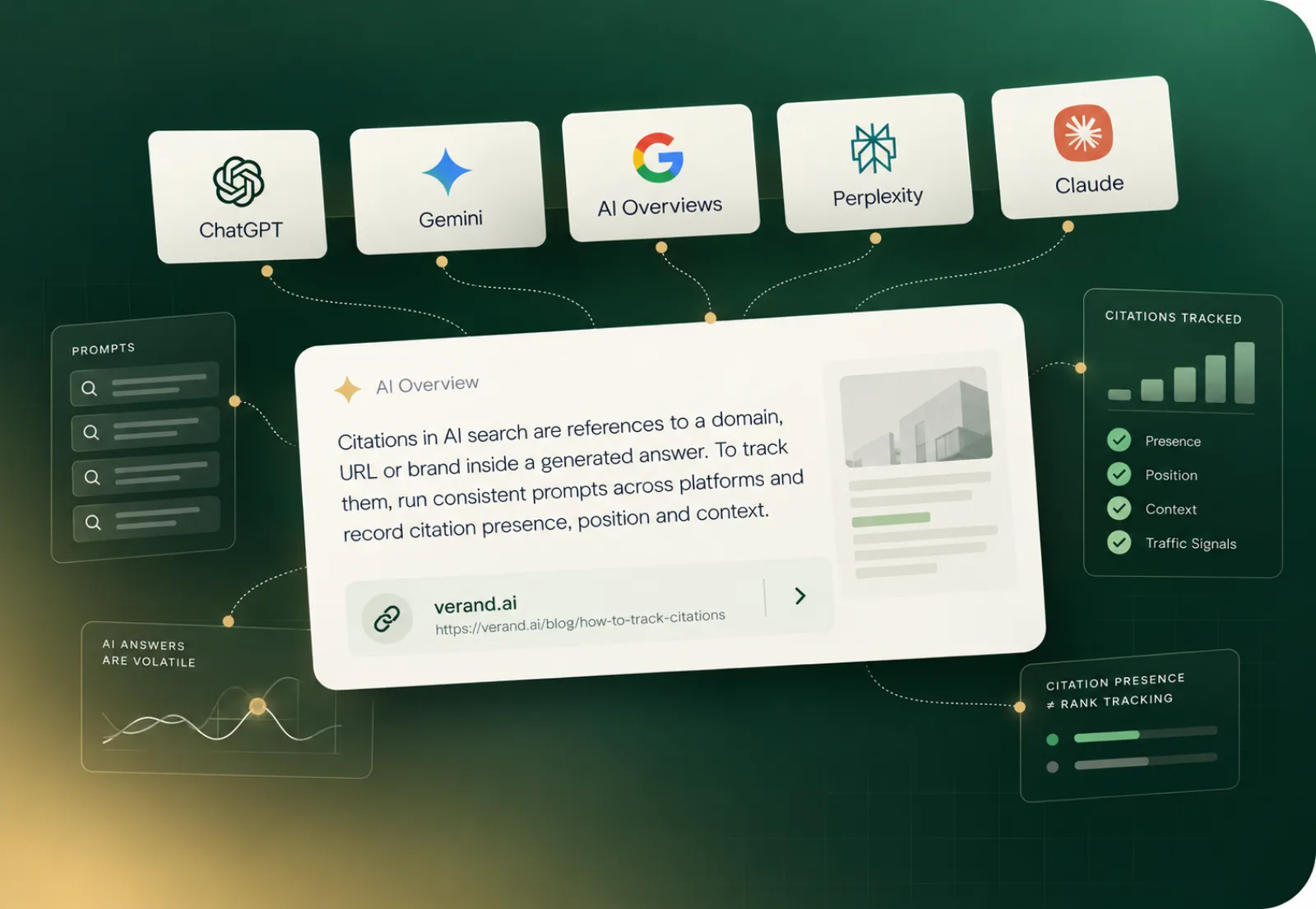
Google AI Overviews alone handles 15 billion daily queries. That volume means a meaningful share of your potential audience now reads an AI-generated answer before it ever sees a traditional search result. To track citations in AI search is to measure whether your content appears in those answers, which platforms surface it, and how often. That data is now a core input to brand visibility strategy, not a niche experiment.
Key takeaways
- AI Overviews serve 15 billion daily queries, making citation presence a direct traffic and brand exposure variable.
- AI Overview content changes 70% of the time, so one-time audits miss most of the picture.
- Spreadsheet tracking works for 20 to 50 prompts; beyond that, automation becomes necessary.
- GA4 and Google Search Console can estimate AI-driven traffic without a dedicated paid tool.
The methods range from a weekly spreadsheet run covering 20 to 50 prompts, which requires no tool investment, to automated monitoring across six platforms for teams managing larger prompt sets. Neither approach requires abandoning your existing SEO workflow. Citation presence and organic rankings are complementary signals, and the teams building a tracking habit now will have a measurable edge as AI search matures.
What Citations Mean in AI Search
A citation in AI search is not a backlink. It's a reference: your domain, a specific URL, or your brand name appearing inside an AI-generated answer. When ChatGPT answers "what's the best project management software for small teams" and lists your product with a source link, that's a citation. When Google AI Overviews summarizes "how to reduce employee turnover" and pulls from your HR blog, that's a citation too.
The distinction from traditional backlinks matters for measurement. A backlink is a persistent HTML attribute you can audit with a crawler. An AI citation is ephemeral: it appears in a generated response to a specific prompt, at a specific moment, and may not appear the next time someone asks the same question. That behavioral difference changes everything about how you track it.
Citation presence signals to AI systems that your content is authoritative on a topic, similar to how link equity signals authority to Google's crawlers. The analogy isn't perfect, but it's operationally useful: citations in AI answers compound over time, reinforcing which domains the model associates with a given subject. A brand that appears consistently across prompts builds a kind of topical authority inside the model's weighting, and that's worth measuring deliberately.
The Scale of AI Search Traffic
The concern about AI search displacing organic traffic isn't hypothetical. Google AI Overviews now handles 15 billion daily queries,1 a volume that makes it one of the largest single surfaces for brand discovery. A meaningful portion of those queries end with the user reading an AI-generated answer and never scrolling to the organic results below.
That doesn't mean organic rankings stop mattering. They don't. But the two surfaces are now feeding different parts of the same buyer journey, and measuring only one of them leaves a gap in your performance data. Brand awareness remains a top marketing priority through 2026 alongside conversion and revenue goals,2 and AI search is increasingly where that awareness is formed.
The practical implication: if your content isn't appearing in AI-generated answers for the queries your buyers are asking, a portion of your potential audience is forming opinions based on competitors who are cited. That's a brand exposure gap that doesn't show up in your rank tracker, your Search Console impressions, or your GA4 session data unless you're specifically looking for it.
The Volatility Challenge: Why One-Time Audits Fail
AI Overview content changes 70% of the time,3 which is the single most important operational fact for anyone building a citation tracking program. A one-time audit tells you where you stood on the day you ran it. It says nothing about whether you're cited next week, or whether a competitor displaced you after updating their content.
That said, the volatility picture is more nuanced across platforms. In practice, LLM-based systems like ChatGPT and Perplexity show considerably less week-to-week churn than Google AI Overviews. The cited sources in a ChatGPT response to a stable informational query tend to stay relatively consistent over a 4 to 8 week window. What shifts more often is position and context: a domain that was cited second may move to first, or the framing around the citation changes even when the source URL stays the same.
Google AI Overviews behave differently, reflecting the real-time index and fresher content signals. That's where the 70% figure originates, and it's why monitoring frequency needs to match the platform. Weekly checks are a reasonable baseline for most teams. Daily checks make sense only if you're tracking a high-stakes prompt set where a citation gap has a direct revenue consequence.
 AI Overviews
 ChatGPT
 Perplexity
AI Citation Tracking vs. Traditional SERP Tracking
Traditional rank tracking is deterministic: enter a keyword, get a position number. A SERP displays 10 organic results in a predictable format, and the same crawler can check the same keyword at scale with minimal variance.4 The measurement infrastructure built around that model, rank trackers, Search Console, GA4 organic sessions, assumes a relatively stable result set.
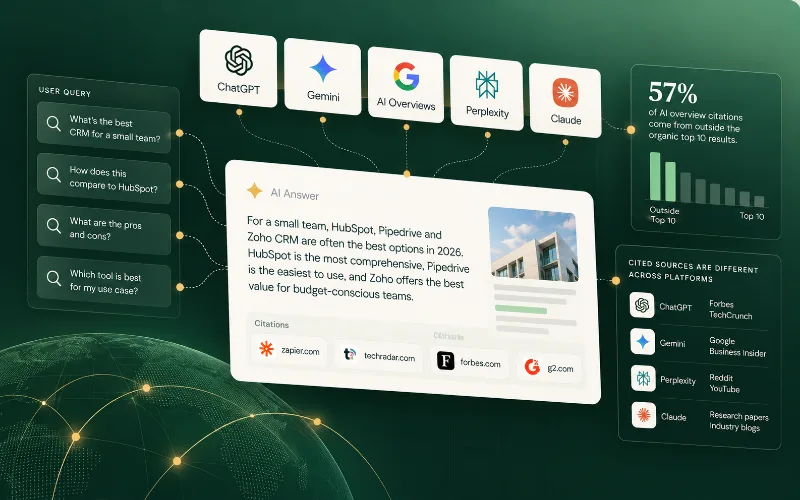
AI citation tracking breaks each of those assumptions. The "result" is a generated paragraph, not a list of URLs. The cited sources are embedded in prose, not displayed as discrete ranked items. The same prompt submitted twice can produce different answers with different citations. And the six major AI platforms (ChatGPT, Gemini, Google AI Overviews, Google AI Mode, Perplexity, and Claude) each have distinct citation behaviors, training data cutoffs, and source preferences.
This means citation tracking requires a different measurement layer, not a replacement for rank tracking. You're running prompts, logging outputs, and recording which domains appear, in what position, and with what context. That's a more manual, interpretive process than pulling a position number from an API. The upside is that the data is richer: you learn not just whether you're cited, but how you're characterized, which matters for brand perception in ways that a rank position never captured.
Platform Differences That Affect Your Tracking Strategy
Treating ChatGPT, Perplexity, and Google AI Overviews as interchangeable is a reliable way to build a tracking program that misleads you. Each platform has different citation behaviors, and those differences affect both what you measure and how you interpret the results.
Google AI Overviews pull from the live index and favor recently updated, well-structured content. Pages with clear answer formatting, tables, and explicit key takeaways tend to appear more often. The 70% volatility rate reflects that freshness bias: the index moves, and the overview moves with it.
Perplexity cites sources explicitly and displays them as numbered references, making citation detection relatively straightforward. ChatGPT's behavior depends on whether the user is running a web-browsing session or relying on the base model. The base model doesn't cite real-time sources, so tracking citations there requires a different approach than tracking Perplexity or AI Overviews.
In competitive analysis across the same prompt set, domains with higher authority tended to appear more frequently across platforms. But the content variables mattered too: pages that answered the query directly in the opening paragraph, used structured formatting like tables, and included explicit key takeaways showed up more consistently than longer, less structured pages on the same topic. That pattern held across platforms, even when the platforms disagreed on which specific URL to cite.
Manual Tracking: The Spreadsheet Method for Smaller Prompt Sets
For teams monitoring 20 to 50 prompts, a spreadsheet-based approach works and requires no tool investment.5 The setup takes a few hours, and the weekly run takes 30 to 60 minutes depending on prompt count and how many platforms you're checking.
The basic structure: one row per prompt, columns for each platform you're tracking, and a cell that records whether your domain was cited (yes/no), the position if applicable, and a brief note on context. Run the same prompts weekly, log the results, and track changes over time. A simple percentage, citations divided by total prompt runs, gives you a citation rate you can trend.
| A | B | C | D | E | |
|---|---|---|---|---|---|
| 1 | Prompt | ChatGPT | Perplexity | AI Overviews | Context |
| 2 | best CRM for a small team | Yes · #2 | Yes · #1 | No | listed with two others |
| 3 | CRM vs spreadsheet for 5 reps | No | Yes · #3 | No | named, no link |
| 4 | does HubSpot work for real estate | Yes · #1 | Yes · #2 | Yes · #1 | “the clearest comparison” |
| 5 | CRM pricing for a startup | No | No | No | competitor cited instead |
| 6 | how to migrate from Pipedrive | Yes · #1 | No | Yes · #2 | quoted a step from the guide |
| 7 | Citation rate | = 8 cited ÷ 15 runs53% | |||
Where manual tracking breaks down is at scale. Once you're monitoring more than 10 platforms or prompt variants, the spreadsheet becomes difficult to maintain consistently, and human error in logging starts to distort the trend data. The transition point isn't a fixed number; it depends on team capacity and how frequently you need results. But the operational friction of manual tracking tends to become apparent before the data quality does, and that's usually what forces the switch to dedicated tooling.
Start manual. It forces you to read the actual AI answers rather than just logging a metric, and that qualitative exposure is useful for understanding how your brand is being characterized, not just whether it appears. For deeper guidance on prompt construction and citation prompt engineering, see the AI instructions resource.
Setting Up a Citation Monitoring Workflow
The hardest part of building a monitoring workflow isn't the tooling; it's defining which prompts to track. Most teams either start too broad (tracking every keyword in their rank tracker) or too narrow (tracking only their brand name). Neither produces useful citation data.
The right starting point is the set of queries your customers actually ask when they're in the consideration or decision stage. That's not the same as your highest-volume keywords. A query like "what's the best [category] tool for [use case]" is more likely to trigger an AI-generated answer with citations than a navigational query like your brand name. High-intent informational prompts are where citation presence converts to brand exposure.
Identifying that prompt set is non-trivial. Verand's approach is to run a full brand extraction against the customer's site and their competitors' sites, then model which queries the customer's audience is likely to ask based on that content landscape. That process surfaces prompts you wouldn't have thought to track manually, particularly in adjacent topic areas where competitors are already being cited.
Once you have your prompt set, define the logging cadence (weekly is standard), the platforms you're checking, and the four metrics worth recording: citation presence, position within the answer, context (how your brand is characterized), and any traffic signal you can tie back to the prompt.
Using GA4 and Google Search Console to Estimate AI-Driven Traffic
You don't need a dedicated paid tool to start measuring the traffic impact of AI citations. GA4 and Google Search Console, used together, can give you a reasonable estimate of how much traffic is arriving via AI-generated answers.6
In Search Console, filter your performance data by query type and look for impressions and clicks on queries where AI Overviews are known to trigger. Compare click-through rates on those queries to your baseline CTR for similar informational queries. A suppressed CTR on a query where you rank well organically is often a signal that an AI Overview is absorbing clicks above your result.
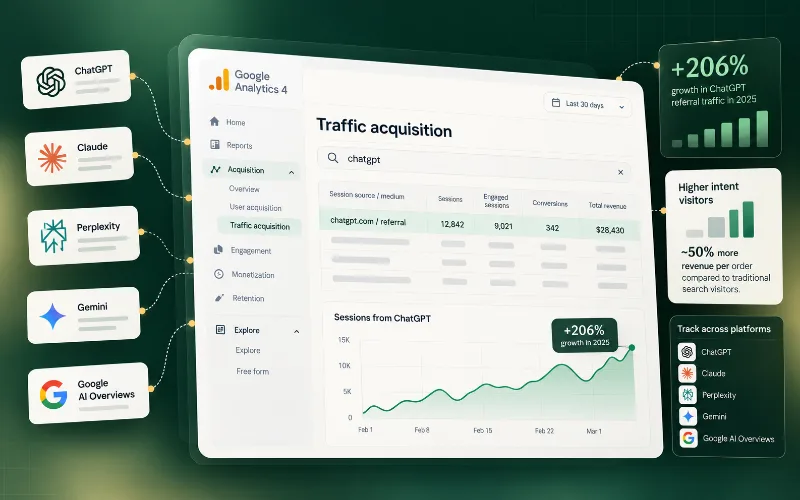
In GA4, use event parameters to segment traffic by source. Direct traffic and sessions with no referrer have increased on most sites since AI Overviews expanded, partly because users click a citation link in an AI answer and the referrer is stripped or attributed as direct. Setting up a custom channel grouping that captures AI referrer strings (where they exist) gives you a cleaner separation.
These methods are approximations. They don't tell you which specific prompts drove traffic or which platforms cited you. But they're sufficient to establish whether AI search is a material traffic source before you invest in dedicated monitoring infrastructure, and they're available to any team with standard analytics access.
The Visibility Score: Standardizing Citation Performance
A citation rate (percentage of prompts where your domain appears) is useful but hard to benchmark in isolation. A 0 to 100 Visibility Score normalizes citation performance across platforms and prompt sets, making it possible to compare your performance over time and against competitors on a consistent scale.7
The score typically weights citation presence, position within the answer, and frequency across the prompt set. A citation that appears first in a detailed AI answer scores higher than a passing mention buried in a longer response. Aggregated across your full prompt set and normalized to 100, the score gives you a single number you can trend weekly.
The important caveat: a Visibility Score is a summary metric, not a diagnostic. A score of 62 doesn't tell you which prompts you're missing, which platforms are underperforming, or what content changes would improve it. Use the score for executive reporting and trend monitoring. Use the underlying prompt-level data for diagnosis and optimization decisions.
Verand tracks share of voice, mentions, citations, and sentiment across ChatGPT, Gemini, Google AI Overviews, Google AI Mode, Perplexity, and Claude, prompt by prompt. That granularity is what makes the summary score actionable rather than decorative: you can see exactly where the score is being dragged down and address it with specific content changes.
Identifying Citation Gaps Through Competitive Analysis
A citation gap is a prompt where a competitor is cited and you aren't. Identifying those gaps systematically is how citation tracking converts from a measurement exercise into a content strategy input.
The process is straightforward: run the same prompt set against your domain and one or two direct competitors. For each prompt where a competitor appears and you don't, examine the cited page. What format does it use? Does it answer the query in the first paragraph? Does it include a table, a list, or a structured comparison? Those content variables, not just domain authority, often explain the gap.
In practice, higher-authority domains do have a baseline advantage in citation frequency. But that advantage is smaller than most teams expect, and it's frequently overcome by content structure. Pages that answer the query directly at the top, use tables to organize comparative information, and include explicit key takeaways tend to outperform longer, less structured pages on the same topic, even when the longer page has more backlinks.
Gap analysis also surfaces topic areas where you have no content at all but competitors are being cited regularly. Those are the highest-priority content opportunities: prompts where you're invisible not because your content wasn't chosen, but because you haven't written anything the AI can cite.
When to Scale from Manual to Automated Tracking
The spreadsheet approach works until it doesn't. The inflection point is typically around 50 prompts across multiple platforms, but the practical signal is simpler: when maintaining the tracking log starts taking more time than acting on the data, you've outgrown manual.
Automated citation tracking tools query AI platforms programmatically, log results to a database, and surface trends without requiring a human to run each prompt manually. That changes the economics of monitoring: instead of 60 minutes of weekly manual work for 30 prompts, you can track 300 prompts across six platforms with the same or less human time.
Tool selection depends on team size, budget, platform scope, and how you need to report the data. Some tools specialize in Google AI Overviews; others cover a broader set of AI platforms. Before committing to any tool, confirm which platforms it actually monitors (not just which ones it claims to support), how frequently it runs prompts, and whether the output integrates with your existing reporting stack.
One consideration that's easy to overlook: data handling. If you're running prompts that include client names, proprietary product information, or sensitive competitive data, you need to understand how the tool stores and processes that input. Organizations handling citation data at scale should evaluate SOC 2 compliance requirements before selecting a tool or method for managing that data; the AI policy framework outlines the governance considerations that apply to citation tracking programs.8
Citation Presence as a Brand Authority Signal
Citations in AI answers function as authority signals in a way that's structurally similar to backlinks in traditional search. A backlink from a high-authority domain tells Google that another credible source vouches for your content. A citation in an AI answer tells the user, and indirectly the AI system, that your domain is a reliable source on the topic.
The compounding effect is real. Domains that are cited consistently across a topic area tend to be cited more over time, as the model's association between that domain and the topic strengthens. This isn't a guaranteed outcome, and it's not a mechanism you can game with a single well-optimized page. But it does mean that early, consistent citation presence has a cumulative value that goes beyond any individual answer.
For brand awareness specifically, the citation context matters as much as the presence. An AI answer that cites your domain while accurately characterizing what you do reinforces brand perception. An answer that cites you in a misleading context, or attributes a claim to you that you didn't make, is a brand risk. That's why monitoring context, not just presence, belongs in your tracking workflow from the start.
Brand awareness remains a top marketing priority through 2026 alongside conversion and revenue goals,9 and AI search is now a primary surface where that awareness is formed for a growing share of buyers.
Connecting Citation Data to Content Strategy
Citation tracking produces two kinds of output: a performance signal (are we being cited?) and a content signal (what's being cited, and why?). Most teams use the first and ignore the second. That's a missed opportunity.
The content signal is more actionable. When you examine which pages are consistently cited across platforms and prompts, patterns emerge: specific formats, topic angles, and structural choices that AI systems favor. Pages that answer the query directly in the opening paragraph, use tables to organize comparative data, and include explicit key takeaways appear more often than longer, less structured pages on the same subject, even when the latter has more backlinks. That's a content brief in data form.
Use citation data to prioritize your editorial calendar. Prompts where competitors are cited and you have no content represent your highest-priority gaps. Prompts where you're cited inconsistently, appearing in some runs but not others, usually point to content that answers the query but buries the answer too deep, or lacks the structural signals that help AI systems extract and attribute it cleanly.
The feedback loop is the point. Citation tracking isn't a reporting exercise you run in parallel to content strategy. It's an input that makes content decisions more precise: which topics to write, which formats to use, and which existing pages to restructure rather than replace. The Verand blog covers citation tracking best practices and emerging measurement methods as the AI search landscape develops.
AI Search Visibility Tracking: The Bottom Line
Citation presence in AI-generated answers is now a measurable variable in brand visibility strategy. The scale is real: 15 billion daily queries through AI Overviews alone, with content that changes 70% of the time. A one-time audit misses most of it, and a rank tracker doesn't see any of it. The teams building a tracking habit now, even a manual spreadsheet covering 30 prompts, will have baseline data when their leadership starts asking about AI search performance.
The methods described here scale from free (GA4, Search Console, a spreadsheet) to automated. If you're evaluating tools that handle the monitoring at scale, Verand tracks citation presence, share of voice, and sentiment across six AI platforms, prompt by prompt, alongside the keyword and content analytics that feed the same editorial decisions. The trial starts with your Report Card already built.
Frequently asked questions
How is an AI citation different from a featured snippet?
A featured snippet pulls a fixed excerpt from a single page and displays it at position zero. An AI citation is embedded in a generated answer that synthesizes multiple sources, and the cited domain may or may not receive a visible link depending on the platform.
Do AI platforms cite the same sources as Google's organic results?
Not consistently. High-authority domains appear across both surfaces, but AI platforms weight content structure and direct answer format heavily. A page ranking at position 8 organically can be cited more often than the page at position 1 if it answers the query more directly.
How many prompts should I start tracking?
Start with 20 to 30 high-intent informational queries your buyers actually ask during the consideration stage. That's a manageable manual set and enough to establish a baseline citation rate before deciding whether to expand or automate.
Can I tell from GA4 whether a session came from an AI citation?
Partially. Some AI platforms pass referrer strings; others strip them, and the traffic appears as direct. A custom channel grouping in GA4 can capture the referrers that do pass through, but a meaningful portion of AI-referred traffic will remain unattributed without additional tooling.
Does improving my citation rate require a separate content program from my existing SEO work?
No. The content changes that improve citation rates, direct answers early in the page, structured formatting, explicit key takeaways, also improve organic performance. The programs share most of their inputs and should be run together, not as separate workstreams.
Sources
External
- ahrefs.com, "How to Track AI Overviews"
- blog.hubspot.com, "AI Citation Tracking"